

Goodflex Rubber Limited
With more than two decades of experience, Alcester-based Goodflex Rubber is a UK manufacturer of high-performance silicone and rubber hose solutions, mouldings, and engineered assemblies for specialist sectors.
With more than two decades of experience, Alcester-based Goodflex Rubber is a UK manufacturer of high-performance silicone and rubber hose solutions, mouldings, and engineered assemblies for specialist sectors.
For over twenty years, Alcester-based Goodflex Rubber, a UK manufacturer of high-performance silicone and rubber hose solutions, mouldings and engineered assemblies serving specialist sectors, had relied on a custom-developed, externally-sourced, manufacturing and product configuration system, designed around the business’s exact requirements.
“Hose manufacturing of this calibre is surprisingly complex,” says Natalie Benwell, Goodflex’s Commercial Manager.
“Product configuration is essential for our business because every component we manufacture is custom-built and made to order. Our previous system supported our operations exceptionally well; it evolved alongside our processes and was purpose-built for the way we work.”
The problem was that Microsoft Access, the database on which Goodflex’s system was built on, was approaching end-of-life and the sole developer was approaching retirement.
Although this did not create immediate operational vulnerability, it prompted a strategic reassessment. “By late 2022 we had begun to recognise the growing level of risk exposure for the business,” recalls Natalie. “It became clear that continuing with the platform no longer aligned with our long-term growth ambitions and governance strategy, and that we needed to transition to an alternative solution.”

The business was aware of the Made Smarter digital innovation initiative, funded by the UK government and delivered by Innovate UK, the Engineering & Physical Sciences Research Council and the Economic & Social Research Council.
Having contacted Made Smarter in early 2023, Goodflex was pointed to Warwick University’s prestigious Warwick Manufacturing Group, which worked with the business to put together a specification of the precise capabilities that it was looking for in a manufacturing system.
“This was enormously helpful, and clarified a lot of our thinking,” notes Natalie. “It also helped us to see that rather than just needing a basic MRP system to replace the capabilities of the existing system, we’d be better off moving to a full ERP system.”
With the specification complete, the Warwick team provided a shortlist of vendors most closely aligned with Goodflex’s criteria. They then supported Goodflex in evaluating the responses, including accompanying the team to vendors’ system demonstrations.
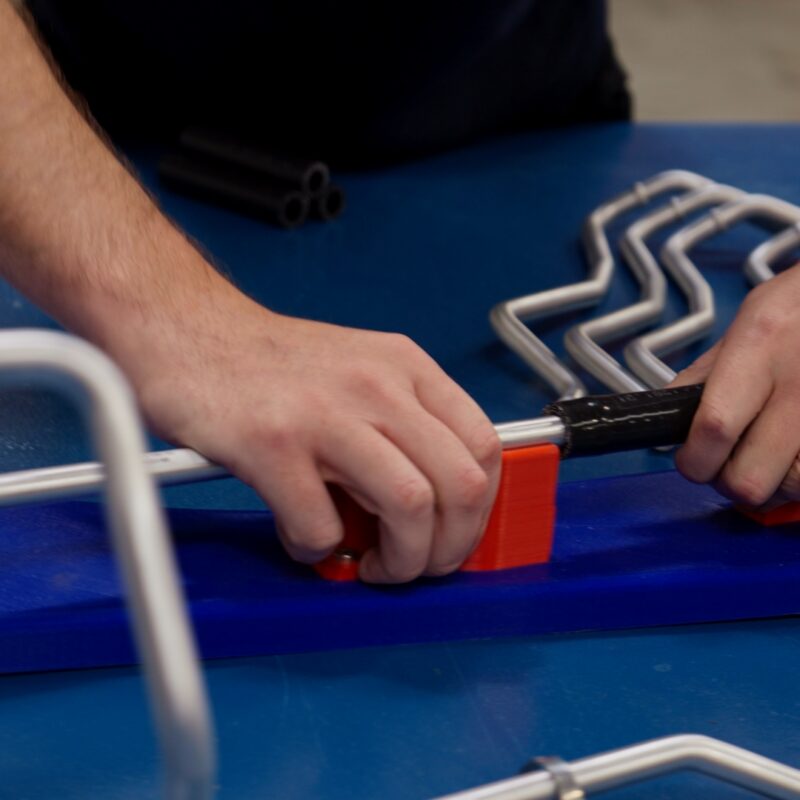
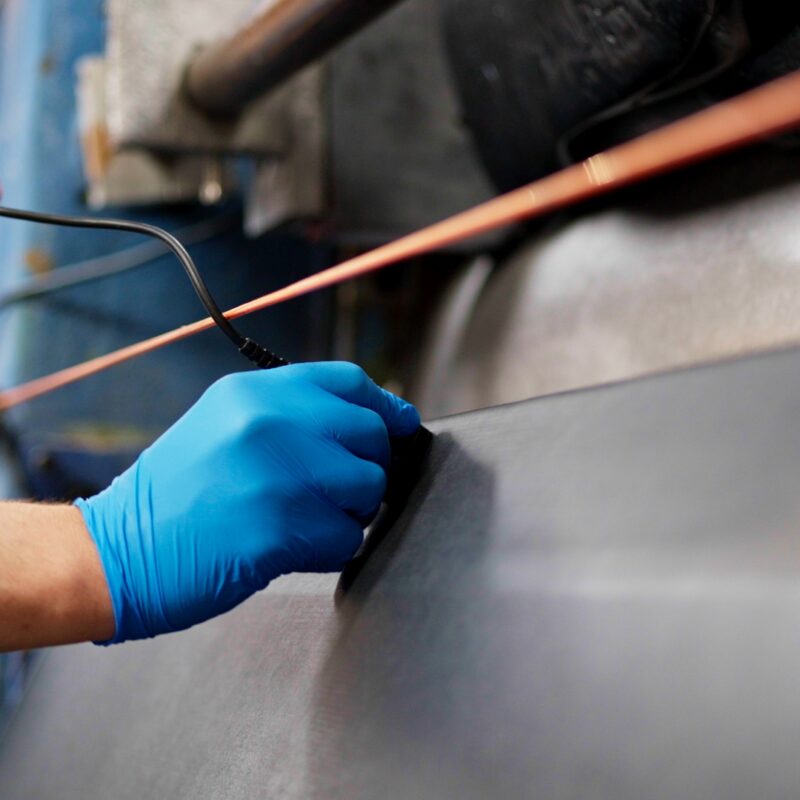
Goodflex had a number of clear priorities in terms of the functionality that it was looking for in EFACS E/8, relates Natalie.
Among them – product creation using the EFACS E/8 product configurator, sales orders, purchase orders, manufacturing control and visibility, invoicing & accounts.
The plan – focus initially on these priorities and implement them using the standard, ‘vanilla’ version of EFACS E/8. This would be Phase 1. Then, with the confidence and experience gained, the company moved forward with Phase 2, which would add more functionality, as well as making any customisations that seemed appropriate, using EFACS E/8’s inbuilt customisation tools.
“We knew that EFACS E/8 had extensive customisation capabilities, but we only wanted to engage in customisation once we were familiar with the software and understood the full implications of what we were doing,” sums up Natalie.
Initially, however, before installation, Goodflex took the opportunity to undertake a data cleansing exercise, in order to bring its data on the company’s products into line with what EFACS E/8 required.
“For example, in our existing product data, we had a number of different coding and naming conventions in place, depending on who had produced it” she explains. “In addition, our existing approach had been to incorporate revision version numbering into the product name, whereas EFACS E/8 allowed us to have a product name with multiple, separate revision versions under the same part.”
Finally, all the implementation preparation was complete. In September 2024, Goodflex’s EFACS E/8 successfully went ‘live’, with all the intended functionality in place.
As a precaution, a decision had been taken to run the old system in parallel for one month, in order to check the information that EFACS E/8 was producing against the information produced by the old system. But after one month, this period of parallel running was concluded, and the old system formally retired.
Right from the start, says Natalie, it was clear that EFACS E/8 was delivering the sought-for benefits. And, as opposed to a manufacturing system surrounded by a set of disparate supporting systems, Goodflex now had a single, comprehensive ERP system.
So, after a period of six months, it was time to move beyond Phase 1 and move onto Phase 2 – customising EFACS E/8 and adding additional functionality.
Two obvious areas of additional functionality were management reporting, and automating processes for efficiency, she relates – “these were important, and priorities, but not important enough to warrant delaying Phase 1.”
Accordingly, training for EFACS E/8’s BIRT report-writing capabilities took place and work on developing and implementing management reports began.
“Initially, these reports would have had to have been run manually, when required,” says Natalie. “Now, they’re produced automatically and simply appear in employees’ in-boxes.”
Shopfloor data collection had previously been carried out by typing in hand-written worksheets gathered from the factory floor each day. In phase 1, Goodflex moved to real-time shopfloor data collection, using ruggedised Samsung tablets on the factory floor, supplemented by a pair of Zebra barcode scanners.
Plans for the future – Phase 3 – has begun to include enhancements to automated workflows and the automated generation of key documentation, such as certificates of conformity and quality assurance test certificates.
Capacity planning functionality, too, is also scheduled for rollout, with a test implementation of this being scheduled for later in 2026, with further system enhancements planned in line with the continuous improvement roadmap.
Overall, Goodflex is already delighted with what it has achieved with Exel’s EFACS E/8 – such future developments merely add to the returns already achieved. And, of course, the overarching strategic benefit was achieved right from the outset – resilience. “EFACS E/8 has given us a consistent, reliable system, backed by a dependable support network, giving the business the stability of an off-the shelf system that we can use to finetune to our needs” sums up Natalie. “To say we’re well-satisfied is an understatement.”
Contact our team of experts to discuss your business requirements. Our team will discuss how Exel’s ERP & Field Service Management software can benefit your business processes and arrange a product demonstration.
Contact Us